Looking at communication through the lens of the Human Design Throat Centre
One of my very first Human Design readings was for a woman who wanted to understand herself better. She knew quite a few things about her Design already. Towards the end of the reading she said “You know, I am not sure if I have what it takes to be a good coach, I am not very good at making bold statements”.
She had told me a little about herself during our session.
She had grown up in America. Her father was American, her mother Japanese, and she had a brother. She told me that her father was a teacher, and she had often felt small compared to her father and brother because they had always known what to say. They had loud, clear voices and strong opinions.
While her voice, as well as her mum’s, seemed small in comparison. She had often not known what to say, or felt she had little to contribute. She said that her father had often told her that she needed to talk louder, bolder, and with more certainty – something that she felt didn’t come naturally to her, and didn’t feel very accessable either.
So, she wondered if she could be a good coach. I asked her if she felt she could be a good coach. She paused for a moment and said “my friends often compliment me on the questions I ask. They always say that my questions help them understand something – or solve something”.
When Did Different Become Wrong?
My first thought was “wow, this is amazing. She comes from a family that has roots in the West and the East. Her father almost seemed to represent how we are taught to communicate in the West: loud, certain, leading. While she naturally communicates in a way that, at least according to what I was taught at school, is often considered wise in the East: through asking thoughtful questions that allow the other person to find their own answers.”

How often do we mistake different for deficient?
I also couldn’t help noticing how her family almost stereotypically mirrored that men are loud and certain, while women are more timid and quiet.
Yet, that wasn’t how I had perceived her during our session. Nor was it how she had described her family. What came next to my mind was the image of Yin and Yang. Reminding me that things don’t have to be done a particular way. That there are more paths. That there is often no right or wrong. Just different.
And it made me realise how often we mistake difference for deficiency.
When I looked down onto her Human Design chart, I noticed that her throat centre was undefined.
Different Ways to Communicate
In Human Design communication is governed by the throat centre. The more you study the throat centre and how it can be defined, the more you realise just how many different ways there are to express ourselves. You also realise how all those variations are powerful in their way.
Different – but never weaker. Each definition has its own strengths. Each of us have our own way to communicate.
All of us live by the standards we think we need to fulfill. But what if those standards simply describe how another person communicates successfully? What if each of us has our own way?
Taking it a perspective further… What if our own way of communicating isn’t wrong at all? Maybe not supportive in every situation – but why should that necessarily then be wrong? What if it simply wasn’t for everyone? Or for every place? What if it was the right style and way for some people? Our people.
Why would there have to be universal, ideal way? In fact, is that even possible?
What if we each have the right voice for the places where we naturally belong? Or what if the communication style that naturally suits us, is in fact right for the environment we are in, we just simply haven’t tried it yet? Why do we always assume that we have to mould ourselves to fit the place? Couldn’t we also either shape the place, or look for the places we naturally fit?
The approach is a different one: one looks at the place and asks: “who do I have to become to fit?” The other looks at ourselves and asks: “who am I – and where or how do I fit?”. I don’t think either approach is better or worse than the other.
To me, the more valuable question is simply: Which approach fits me?
A Brief Look at the Human Design Throat Centre
Before I come back to my client’s conclusion about whether she could become a good coach, let me briefly explain the Human Design throat centre.
There are many layers and nuances to the throat centre, but the very first layer you look at is whether the throat centre is defined or not. If your throat centre is defined, the third shape from the top in your body chart is coloured in. If it is undefined or open, that shape is white.
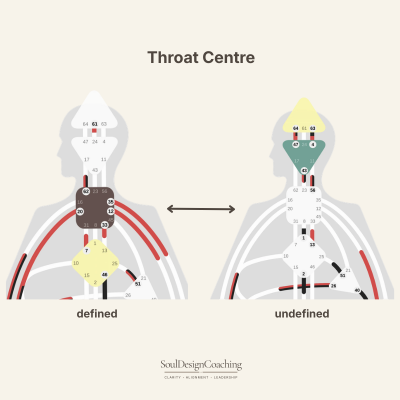
A defined throat centre is usually described like this: “you have a more fixed way of expressing yourself and relatively constant access to your voice.” An undefined throat centre is explained along the lines of “your communication is naturally more fluid and adaptable. You may express yourself differently depending on who you are with.”
What does that actually mean?
If your throat centre is undefined, Human Design suggests that gift lies in trusting the moment. It proposes that the right words often arrive when they are needed. That your strength lives in trusting the moment, spontaneity, presence, and inspiration.
Someone with a defined throat centre, on the other hand, is said to access their innate communication strengths by trusting the channel – or channels – that define their throat centre.
Both require a level of surrender. Just a different kind. The undefined throat centre surrenders to the moment, the defined throat centre to its design.
Human Design as an Invitation
What I like about Human Design is that it can give us a starting point when we feel lost. It gives us words to agree with. Or disagree with. It proposes something about us. A place from which we can begin approaching ourselves from.
For example, in my case Human Design proposed:
“You have a defined throat centre through channel 20-57. You communicate best when you trust the moment and say what arises intuitively – while also being mindful that someone actually wants to hear what you have to say. Else they might struggle understanding you.”
I had to sit with that proposal for months.
I looked at it from different angles, dismissed it. Returned to it. Questioned it. Pulled it apart. Reflected on it. Observed it in my own life. Tested it. Eventually I recognised the pattern. And once I did, it changed everything. I’ll share those reflections in my next article.
Maybe Your Natural Way Is Already Your Strength
Today, I want to challenge the assumption that there is a right way to communicate, and that there would be something wrong with you for not communicating like that. I often observe that many people say that they are not good at communication. But I feel, many people don’t struggle with communication. To me, it seems that the struggle often stems from the belief that the way they naturally communicate isn’t the right way.
But I am not sure if the question: “How do we communicate best?” is always the best question to ask. Maybe the better question is:
“Could your natural way to communicate be your strongest way?”
The way that feels easiest? The way that comes naturally to you. The way that is simply yours.
Understanding parts of our Design – and eventually our whole Design – can be a beautiful doorway into understanding ourselves better. If exploring your Design feels interesting to you, you are very welcome to book a reading with me through this link.
Coming Back To My Client
To circle back to where I began, to that reading that so beautifully demonstrated the strengths of the undefined throat centre to me…. it reminded me beautifully how much culture, upbringing, expectations, and beliefs influence how we evaluate ourselves.
And of course the only correct answer to her question, if she could be a good coach was: “Of course! Your way. With your ability to ask beautifully transforming questions.”
Which brings me back to the point I made earlier: Maybe we don’t always need to fit into the places around us. That is one possible path.
For others, the path is finding the places – and the people – where they naturally belong.
The first path is the one we had to walk for centuries. It was often the only realistic one. Today, thanks to travel, technology, and a much more connected world, the second path has become much more feasible than it once was.
At the end of our session, we concluded that she had everything in her to be an excellent coach. Some coaches coach “the Western way” through telling you how to change something, while others coach “the Eastern way” by asking the exact questions that enable you to find the answer you need for yourself. She belonged to the second group.
Neither is better. Or worse.
They are simply different.
If you enjoyed this post, you can subscribe to my newsletter on Substack and receive each new article straight to your inbox.
