I came across Human Design in 2022 when I was at a crossroads in my life and had just decided to pursue two routes to see which one would stick. I trained as an SEO specialist as well as a Soul Purpose Coach. I love both — analysis of any kind, and contemplating life. A few weeks into both trainings, coaching won, and Human Design hooked me in like nothing ever before.
Human Design is a mystical system channeled in 1987. It brings elements of four ancient traditions into one framework: the I‑Ching, Western Astrology, the Chakra system, and the Kabbalah. Based on a person’s day, time, and place of birth, a chart is generated that helps us understand how we are uniquely wired. It’s often described as an operating manual for ourselves.
To this day, I find it odd that something based on birth data can feel so resonant for so many people. But over time, something else became apparent to me: the wisdom behind each element of Human Design. Much of what Human Design describes applies to everyone. Its wisdom is incredibly logical once you start reflecting on it.
But while many aspects apply broadly, the parts that are defined in a person’s chart tend to play a bigger role in that person’s life — and this is where it becomes fascinating. For a long time, I struggled with the fact that it is mystical rather than a “proper” tool. But after doing over a hundred readings, I realised I no longer cared why it worked. It was helpful to my clients — and that was enough.
What is Human Design?
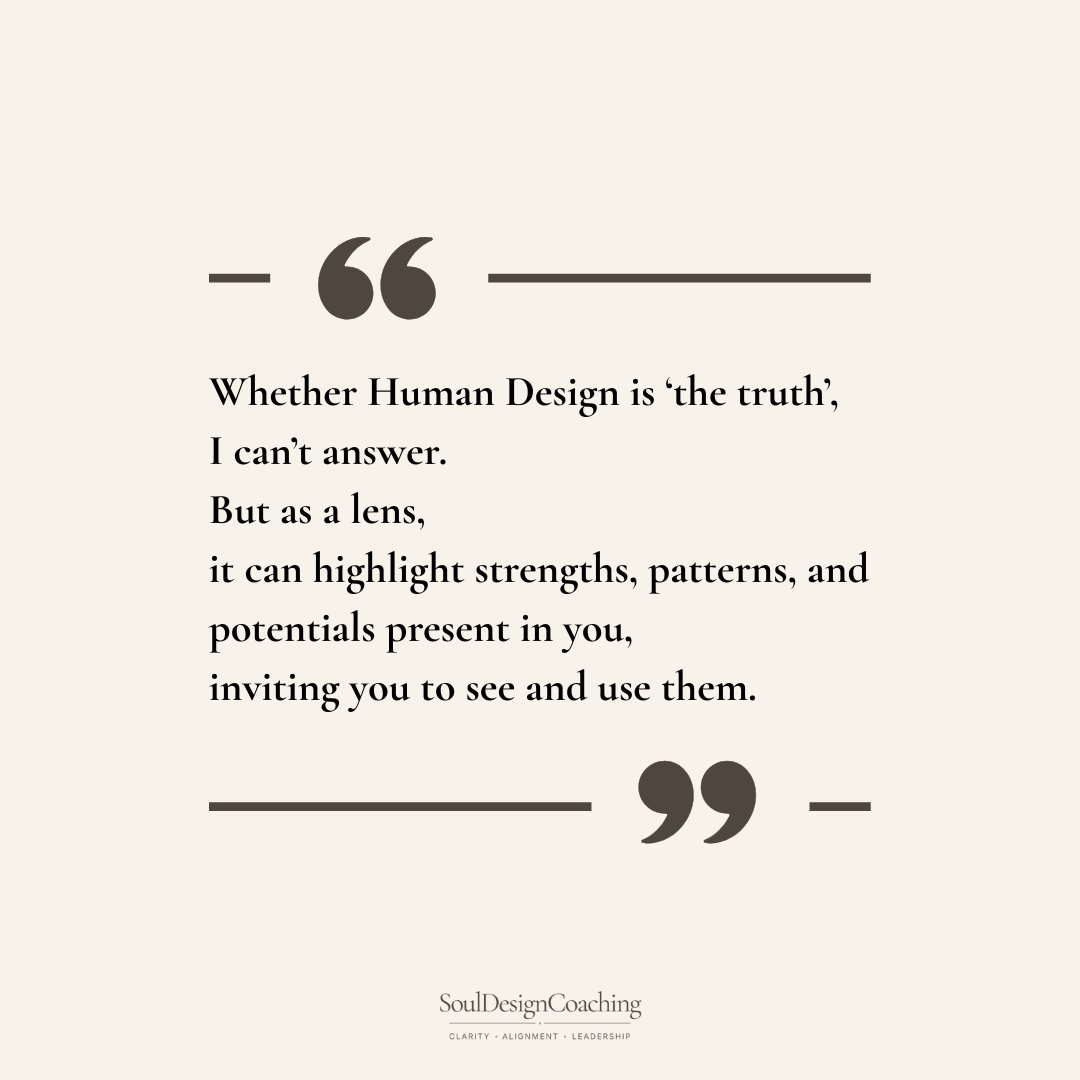
Human Design is a tool for understanding ourselves and each other
One of the most powerful aspects of Human Design, in my opinion, is how it reveals our differences — and how what we often experience as flaws are actually strengths. It helps us understand why we operate the way we do, and why others operate differently.
When we understand difference, we stop needing to be a certain way, and we stop expecting others to behave like us. Things become less personal. We stop assuming we, or others, “should” think or act a certain way.
This alone reduces friction — in ourselves, families, relationships, teams, and organisations.
Human Design gives us vocabulary for these differences. It makes the invisible visible.
At its core, Human Design highlights:
your natural strengths
how you process information
how you make decisions
what energises you
what drains you
where friction tends to arise
how you can work with your nature rather than against it
It doesn’t tell you what to do or who you are. It helps you see yourself through a different lens. It helps you understand where and how you are different — and how that difference is a strength, not a flaw. It offers you a map to experiment with, so you can learn to trust your own inner guidance.
Human Design doesn’t create potential. It helps you recognise it
When people understand what they are naturally good at, they often begin to use their strengths more confidently and intentionally. And when teams understand the strengths already present within their group, they can collaborate with more clarity, determination, and far less frustration.
I strongly believe that we underutilise what is already there. In my experience, there is enormous potential for transformative change in the people and resources that already exist. Adding someone new can be helpful, of course, but it rarely solves the underlying issues — and it often doesn’t tap into the potential that is already present.
What truly changes things is finally seeing what has been there all along. Human Design helps you see it.
My perspective and why I use Human Design in my work
I don’t use Human Design to tell you who you are or what your life should look like. That would be presumptuous. Instead, I use it to offer perspective, language, reflection, understanding, and clarity.
But everyone is so much more than their design. You are also your experiences, circumstances, beliefs, and the meaning you’ve made of your life. You remain the expert of your own life. Human Design simply gives you a map to explore it from a different angle.
I’ve always been able to sense patterns in people — not because I “feel” them intuitively, but because people reveal them in conversation. Yet many don’t recognise how certain experiences have shaped them, what blocks them, what they expect from others, or where those expectations come from. These are the connections I can often see.
When I look at someone through the lens of Human Design, I can offer a different, more empowering perspective. It often becomes clear why we’ve experienced something as a flaw. But from a Human Design perspective, you can often see how something is not a flaw at all — but a strength, once you take additional information into account.
For example, you may not be “inconsistent” — you may simply work differently.
My clients often resonate deeply with what their chart reflects. Not because it tells them something new, but because it puts words to something they’ve always felt. It gives them permission to be themselves.
Human Design helps people trust themselves, understand their needs, recognise their strengths, navigate relationships with more ease, and move through life with more clarity and integrity.
I also love its wisdom. It shows how the same trait can be a strength or a challenge, depending on how we live it — often shaped by our experiences and beliefs. And it offers ideas for how to shift something from challenge to benefit, not just for ourselves but for others too.
Whether I work with individuals, parents, leaders, or teams, Human Design is the lens that helps me illuminate what is already there — so you can work with your nature, not against it.
Human Design for Individuals and Teams
Human Design is often used for personal growth, but its insights apply just as powerfully in professional settings. In organisations, it can help leaders and teams understand:
different working styles
communication patterns
sources of friction
natural roles and contributions
how to collaborate more effectively
I use Human Design in a way that protects privacy and psychological safety. For individuals, I work with full charts. For teams, I don’t initially work with birth information. Instead, I focus on the concepts and structural patterns that help groups see each other more clearly and function well.
The goal is always the same: to help people feel seen, understood, and valued — and to unlock the potential that is already present within the group.
Human Design is a tool for understanding ourselves and each other.
It helps us see difference as potential, not a problem.
It gives us language for what we feel but cannot name.
It shows us our strengths and how we function best.
And it opens the door to more clarity, compassion, and trust — in ourselves and in the people around us.